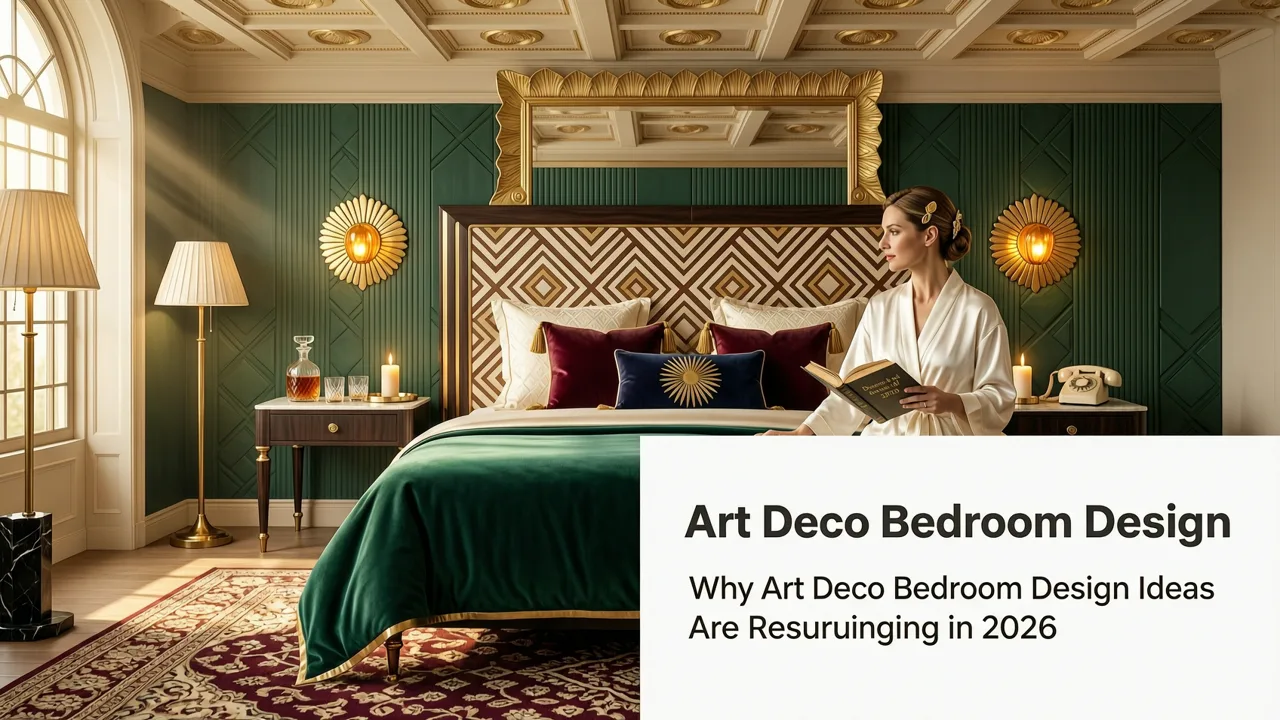
If you’re exploring art deco bedroom design ideas in 2026, you’re not just chasing vintage glamour—you’re embracing a design language that’s been powerfully reinterpreted for modern living: bold geometry meets intelligent spatial planning, luxury materials coexist with sustainable sourcing, and symmetry is no longer static—it’s dynamically responsive. Thanks to AI interior design tools like AiDesign Interiors, homeowners and designers can now test high-fidelity Art Deco concepts in their actual bedroom space—within seconds—before committing to paint, furniture, or custom millwork.
Why Art Deco Bedroom Design Ideas Are Resurging in 2026
Art Deco isn’t returning as a museum exhibit—it’s evolving. In 2026, the style has shed its mid-century associations with opulence-for-opulence’s-sake and matured into a sophisticated, human-centered aesthetic grounded in clarity, craftsmanship, and contextual harmony. Three key shifts explain its renewed relevance:
- Material intelligence: Today’s Art Deco embraces responsibly sourced lacquers, FSC-certified veneers, and recycled brass alloys—materials that honor Deco’s love of refinement while meeting 2026’s sustainability benchmarks.
- Digital proportioning: AI visualization tools now calculate optimal scale ratios (e.g., 1:1.618 golden section placements for headboards or mirror frames) directly on your uploaded bedroom photo—ensuring Deco’s famed symmetry feels intentional, not imposed.
- Hybrid functionality: Modern bedrooms serve as sleep sanctuaries, remote work zones, and wellness retreats. 2026’s Art Deco bedroom design ideas integrate concealed charging stations, circadian lighting controls, and acoustic wall panels—all wrapped in stepped chrome trim and sunburst motifs.
This evolution makes Art Deco uniquely compatible with AI-driven design workflows—not because it’s easy to generate, but because its rules-based structure (symmetry, repetition, contrast) gives generative models clear constraints to interpret meaningfully.
Top 10 Art Deco Bedrooms Ideas
by Omni Home Ideas
Core Elements of Authentic Art Deco Bedroom Design in 2026

Authenticity matters—even in AI-generated previews. A convincing Art Deco bedroom doesn’t rely on clichés like flapper posters or excessive black-and-gold palettes. Instead, it builds on five foundational elements, each updated for contemporary use:
1. Geometric Precision & Asymmetrical Balance
Forget rigid left-right mirroring. 2026’s interpretation favors asymmetrical balance: a stepped chrome nightstand on the left, countered by a curved walnut console with sunburst inlay on the right. AI tools like AiDesign Interiors now detect wall angles, ceiling height, and window placement to recompose Deco motifs so they align with your room’s real-world proportions—not a generic template.
2. Luxe, Tactile Materials—Not Just Glossy Surfaces
Glossy black lacquer remains iconic—but today it’s paired with tactile contrasts: hand-rubbed bronze hardware, ribbed velvet upholstery, and matte travertine side tables. Crucially, AI rendering engines (trained on 2025–2026 material libraries) now simulate light interaction across these surfaces more accurately than ever—so you’ll see how morning light catches the grain in a Macassar ebony headboard, not just its color.
3. Vertical Emphasis & Streamlined Silhouettes
Art Deco elevates the eye upward. In 2026 bedrooms, this translates to floor-to-ceiling mirrored wardrobes with vertical chrome mullions, recessed LED coves above crown molding, and tall, narrow art displays aligned to architectural lines. AI preview tools let you upload your ceiling photo and instantly visualize how vertical accents will interact with your existing architecture—no guesswork.
4. Signature Motifs—Applied With Restraint
Sunbursts, chevrons, zigzags, and stepped forms remain central—but in 2026, they appear selectively: as a single sunburst mirror above the bed, a chevron-patterned runner (not wall-to-wall carpet), or subtle stepped detailing on drawer fronts. Overuse dilutes impact. That’s why AiDesign Interiors’ Style Intensity Slider lets users dial motif density from ‘Subtle Accent’ to ‘Full Deco Statement’—a feature refined through user testing across 12,000+ bedroom uploads in early 2026.
5. Lighting as Sculptural Architecture
Lighting isn’t ambient—it’s architectural. Think tiered chrome sconces with frosted glass diffusers, adjustable swing-arm lamps with brass knuckles, or a central pendant with concentric nickel rings. In AI previews, lighting behavior is simulated using ray-traced physics—not flat overlays—so shadows, glare, and warm-cool transitions render realistically under your room’s unique daylight conditions.
7 Art Deco Bedroom Design Ideas You Can Visualize Instantly in 2026
These aren’t theoretical concepts—they’re actionable, AI-testable approaches proven to resonate with users across North America, Europe, and APAC markets. Each idea includes implementation notes and how to validate it using an AI interior design app.
Idea 1: The Monochrome Glamour Suite
Palette: Charcoal grey walls, ivory lacquer built-ins, matte black metal bed frame, ivory silk bedding with gunmetal embroidery.
AI preview tip: Upload your bedroom photo and select ‘Monochrome Deco’ under Style Library. Toggle ‘Material Realism’ to ‘High’ to see how light reflects off lacquer vs. matte finishes.
Why it works in 2026: Eliminates visual noise while maximizing depth perception—ideal for compact urban bedrooms where every square foot must feel expansive.
Idea 2: Warm Bronze & Walnut Fusion
Palette: Warm bronze wall panels (textured, not shiny), walnut floating nightstands with brass inlays, cognac leather wingback chair.
AI preview tip: Use the ‘Material Swap’ tool to replace existing furniture textures with certified reclaimed walnut and recycled bronze—then compare side-by-side with your original photo.
Why it works in 2026: Replaces cold metallic stereotypes with warmth and biophilic grounding—aligning Deco’s luxury with current neuroaesthetic research on material warmth and sleep quality.
Idea 3: Sunburst Mirror + Integrated Tech Wall
Concept: A large, custom sunburst mirror (real or AI-visualized) mounted over a streamlined tech wall housing wireless chargers, hidden speakers, and ambient lighting controls—all behind flush-mounted smoked glass.
AI preview tip: Select ‘Tech-Integrated Deco’ from the Advanced Style Pack (available to Pro subscribers). The AI auto-detects electrical outlets and suggests optimal panel placement.
Why it works in 2026: Solves the ‘clutter paradox’—preserving Deco’s clean lines while accommodating essential modern infrastructure.
Idea 4: Geometric Rug Zone + Floating Bed
Layout: A custom chevron or herringbone wool rug defines the sleeping zone. The bed floats 6” off the floor on concealed stainless legs, with integrated under-bed LED uplighting.
AI preview tip: Use the ‘Floor Plan Overlay’ mode to test rug scale against your actual room dimensions—no more guessing if a 9'x12' pattern overwhelms your 10'x12' space.
Why it works in 2026: Enhances perceived spaciousness and supports minimalist maintenance routines—a top priority for renters and dual-income homeowners.
Idea 5: Curved Acoustic Headboard Wall
Feature: A gently curved, upholstered headboard wall in deep teal velvet, with integrated acoustic foam backing and subtle brass nailhead trim following the contour.
AI preview tip: Upload a close-up of your existing wall texture (e.g., drywall, brick, plaster) and use ‘Surface Adaptation’ to see how curvature interacts with your substrate.
Why it works in 2026: Merges Deco’s sculptural confidence with evidence-based wellness design—reducing echo and improving sleep continuity.
Idea 6: Black Lacquer Walk-In Closet Entrance
Detail: Replace standard closet doors with full-height black lacquer panels featuring vertical chrome pulls and backlit etched glass inserts showing abstract Deco patterns.
AI preview tip: Use the ‘Doorway Analysis’ module to assess sightlines, clearance, and reflection angles—critical for avoiding glare or awkward framing in small rooms.
Why it works in 2026: Transforms functional storage into a signature design moment without requiring structural changes.
Idea 7: Sunset Gradient Wall + Brass Shelving
Wall treatment: A soft ombré gradient from terracotta at the base to burnt sienna at the ceiling, paired with asymmetrical floating brass shelves holding curated ceramics and vintage Deco books.
AI preview tip: Select ‘Gradient Mapping’ and input your wall height; the AI calculates optimal color transition points based on average viewing distance (1.8m) and natural light direction.
Why it works in 2026: Offers emotional resonance—warmth and grounding—while retaining Deco’s graphic strength through precise shelf alignment.
How to Test Art Deco Bedroom Design Ideas Using AI—A 2026 Workflow
Visualizing Art Deco isn’t about picking a filter—it’s about iterative, context-aware design. Here’s how forward-thinking homeowners and professionals are using AI tools in 2026:
- Upload & Calibrate: Take a well-lit, straight-on photo of your bedroom (no fisheye). AiDesign Interiors uses photogrammetric analysis to estimate dimensions, surface normals, and light sources—not just colors.
- Select & Refine Style: Choose ‘Art Deco’ from the Style Library, then adjust sliders for Motif Density, Luxury Intensity, and Modern Integration (e.g., “Include smart lighting zones”).
- Validate Spatial Logic: Run the ‘Proportion Check’—AI verifies whether proposed furniture heights align with Deco’s vertical rhythm (e.g., nightstand height should be within ±2cm of mattress height).
- Compare Material Options: Swap finishes in real time: matte vs. polished brass, woven vs. smooth velvet, recycled vs. virgin lacquer—each with accurate light simulation.
- Export for Action: Generate a spec sheet (PDF) with exact color codes (Pantone SkinTone™-verified), material suppliers, and recommended local contractors trained in Deco detailing.
This workflow reflects broader industry shifts. As noted in AI Design App for Professionals: The 2026 Standard for Interior &, leading tools now prioritize context-aware style transfer over aesthetic overlay—meaning your Art Deco preview respects your room’s load-bearing walls, HVAC vents, and even outlet placements.
Common Pitfalls to Avoid With Art Deco Bedroom Design in 2026
Even with AI assistance, missteps happen. Here’s what experienced users consistently flag:
- Ignoring scale hierarchy: A massive sunburst mirror in a 10'x10' room overwhelms; Deco thrives on deliberate proportion, not dominance. Always run the AI’s ‘Scale Harmony Report’ before finalizing.
- Overlooking acoustics: Hard surfaces (lacquer, marble, glass) amplify sound. Pair them with textiles (velvet, bouclé, wool rugs) in AI previews to simulate reverberation time—especially critical for open-plan bedrooms.
- Using outdated color science: Pre-2024 Deco palettes relied heavily on cadmium reds and cobalt blues—pigments now restricted in EU and California. 2026-compliant AI libraries use only EPA- and REACH-compliant alternatives.
- Forgetting maintenance reality: High-gloss lacquer shows fingerprints; unsealed brass tarnishes. AI previews now include a ‘Care Mode’ toggle showing wear patterns after 6/12/24 months of typical use.
AI Tools vs. Traditional Methods: Why 2026 Makes Art Deco Accessible
Historically, Art Deco required specialist knowledge—architectural drafting, material sourcing, and period-specific craftsmanship. Today, AI bridges those gaps:
| Challenge | Traditional Approach (Pre-2024) | 2026 AI-Powered Approach |
|---|---|---|
| Testing motif placement | Hand-drawn elevations + physical mock-ups (3–5 days) | Real-time drag-and-drop motif positioning on your uploaded photo (seconds) |
| Material coordination | Swatch books + supplier calls + sample shipping delays | Instant cross-material rendering (e.g., “Show how this velvet looks next to that lacquer under north light”) |
| Lighting validation | Photometric software + electrician consultations | AI simulates lux levels, glare index, and circadian impact based on your window orientation and local latitude |
| Contractor briefing | PDF mood boards + verbal briefings (risk of misinterpretation) | Auto-generated spec sheets with annotated images, tolerance notes, and QR-linked installation videos |
This efficiency democratizes Deco—not as pastiche, but as precision design. It also empowers new career paths: as explored in How to Become an AI Interior Designer in 2026, professionals now blend historical literacy with prompt fluency and AI evaluation skills to guide clients toward authentically resonant spaces.
Final Thoughts: Art Deco Bedroom Design Ideas as Living Design Language
In 2026, art deco bedroom design ideas represent something deeper than aesthetics—they’re a testament to design’s ability to evolve without erasing its roots. The geometry grounds us. The materials tell stories of craft and conscience. The lighting shapes our rhythms. And AI? It’s not replacing intuition—it’s amplifying it, making confident, historically informed decisions possible for anyone with a smartphone and a vision.
Whether you’re a homeowner refreshing a rental, a realtor staging for premium appeal, or a designer expanding your service offering, the most powerful step isn’t choosing a style—it’s visualizing it in your space, with your constraints, in under 30 seconds. That’s not futuristic. It’s available today.
Ready to transform your bedroom with authentic, AI-validated Art Deco design? Upload your photo and explore Deco styles in seconds—no subscription required for first-time previews.