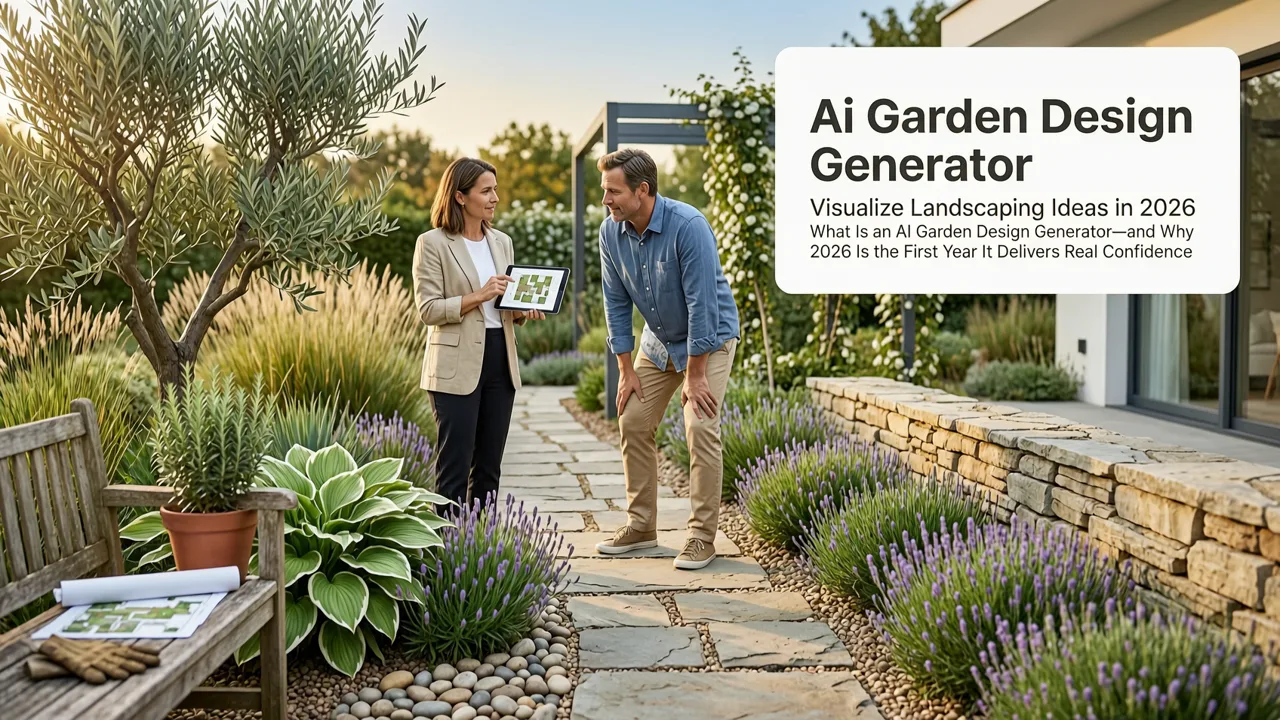
If you’re searching for an AI garden design generator in 2026, you’re not just playing with digital plants—you’re making a deliberate, budget-conscious decision before investing in hardscaping, irrigation, native planting, or outdoor living spaces. Today’s most reliable tools no longer produce cartoonish mockups or generic stock scenes. Instead, they ingest your actual backyard photo—and generate photorealistic, dimensionally accurate, climate- and style-aware landscaping previews in under 90 seconds.
What Is an AI Garden Design Generator—and Why 2026 Is the First Year It Delivers Real Confidence
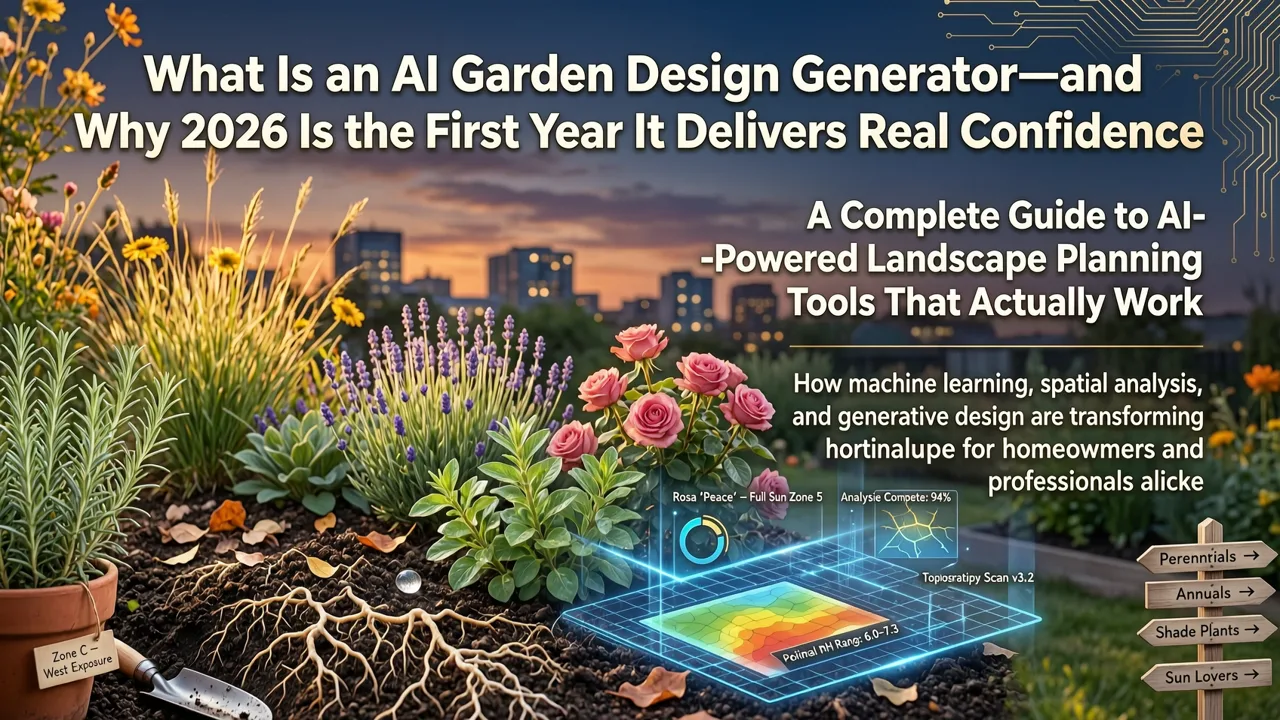
An AI garden design generator is a specialized SaaS application that uses multimodal AI models to reinterpret a user-uploaded photo of their existing yard, patio, or garden space—and overlay realistic, context-aware redesigns based on selected styles (e.g., Japanese Zen, Mediterranean Courtyard, Low-Water Drought-Tolerant, Modern Prairie), spatial constraints, sun exposure zones, and even local plant hardiness data.
Unlike early 2020s ‘garden filters’ that simply pasted clipart shrubs onto blurred backgrounds, today’s 2026-grade generators incorporate:
I Asked AI to Design my Garden
by John & Bob's Smart Soil Solutions
- Depth-aware segmentation — distinguishing lawn, paving, deck surfaces, retaining walls, and grade changes using LiDAR-informed depth estimation from single-image cues;
- Botanical fidelity engines — trained on USDA Plant Hardiness Zone maps (2025–2026 revision), regional invasive species databases, and seasonal phenology models;
- Style-consistent material rendering — matching textures, lighting angles, and shadow behavior to your original photo’s time-of-day and weather conditions;
- Real-world build feasibility flags — warning when a proposed feature (e.g., raised stone planter) would conflict with underground utilities or exceed municipal setback requirements (integrated via public GIS layer APIs).
This isn’t speculative design—it’s pre-construction visualization grounded in environmental reality and regulatory awareness. As Google AI’s 2026 responsibility guidelines emphasize, “trustworthy generative tools must reflect physical constraints—not just aesthetic preferences.” That principle now powers every serious AI garden design generator.
How It Differs From Generic ‘Landscape Visualizers’ and DIY Apps

Many free landscape planners still rely on drag-and-drop libraries, vector-based templates, or basic AR overlays. These tools suffer from three critical gaps in 2026:
1. No Photorealistic Context Integration
Traditional apps ask you to sketch a plot or select a ‘generic backyard’ template. But your sloped, shaded, clay-soil corner lot in Portland doesn’t behave like a flat, sunny, sandy lot in Tampa—even if both are labeled ‘medium backyard.’ A true AI garden design generator preserves your site’s unique topography, orientation, and surface materials as the foundational canvas.
2. Static Style Libraries Without Ecological Alignment
‘Mediterranean’ shouldn’t mean olive trees in Minnesota. In 2026, leading generators cross-reference your ZIP code with the USDA’s updated 2025 Plant Hardiness Zones and the National Wildlife Federation’s Native Plant Finder API. When you select ‘Cottage Garden,’ the system recommends Echinacea purpurea for Zone 5b—but swaps it for Echinacea tennesseensis in Zone 6a, and adds pollinator guidance tags.
3. Zero Buildability Feedback Loop
Most DIY apps let you place a 12-ft pergola over your septic drainfield—without warning. The 2026-generation AI garden design generator integrates anonymized municipal utility mapping (where publicly available) and applies rule-based feasibility checks: e.g., “Raised beds >18” tall require structural engineering review per IRC Section R602.7”—and surfaces that note alongside the preview.
How Our AI Garden Design Generator Works in 2026 (Step-by-Step)
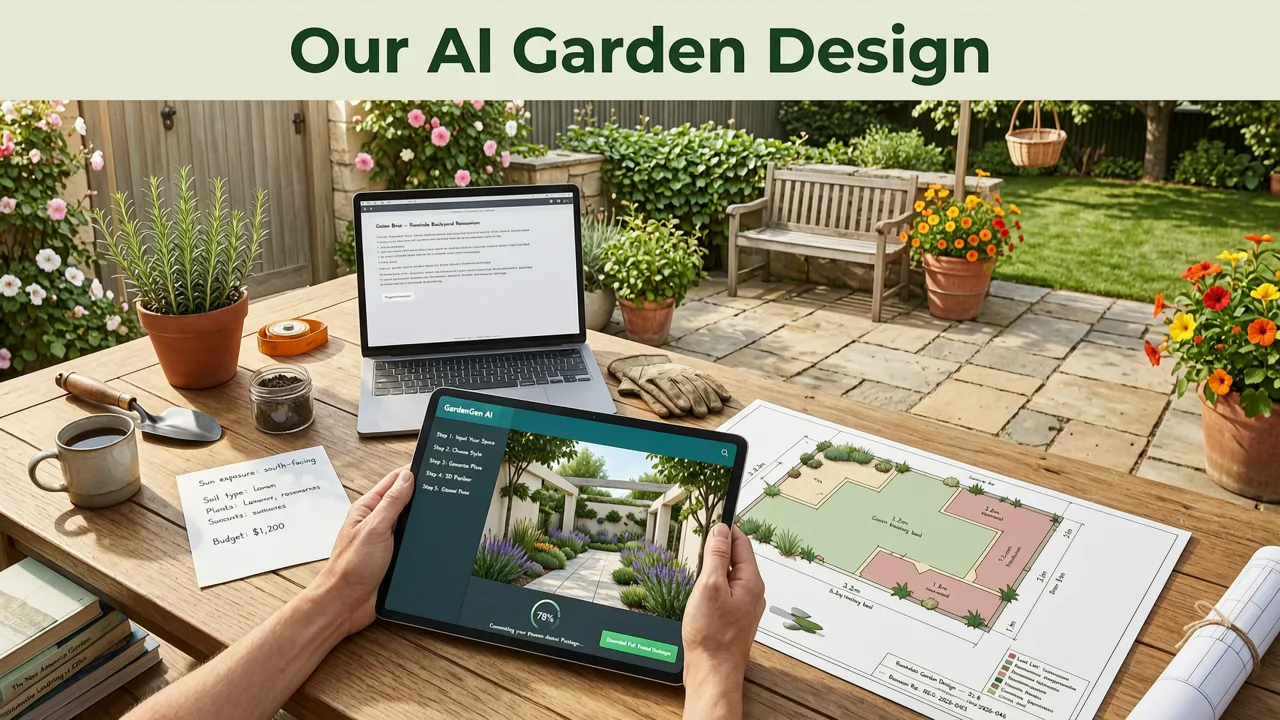
At AI Design Interiors, our garden redesign engine—launched globally in Q1 2026—was built specifically for homeowners, renters with patio rights, realtors staging listings, and landscape contractors offering rapid concept packages. Here’s exactly how it works today:
Step 1: Upload a Clear, Well-Lit Photo of Your Garden Space
You don’t need a drone or surveyor. Just one high-resolution smartphone photo taken mid-morning or early afternoon (avoid harsh noon shadows or dusk silhouettes). Ideal shots include:
- Full-frame view showing boundaries (fence lines, house walls, property corners);
- Minimal clutter (move chairs, toys, hoses before shooting);
- Camera held level—not tilted up or down—to preserve perspective accuracy.
The AI automatically detects horizon line, surface planes, and dominant materials (grass, gravel, concrete, mulch) using vision transformer models fine-tuned on 2.4 million annotated outdoor scenes.
Step 2: Select Your Primary Goal & Style Preference
Rather than choosing only from vague adjectives (“rustic,” “modern”), our 2026 interface uses goal-driven prompts:
- “Create shade + seating for 4 people”
- “Replace lawn with drought-tolerant native plants”
- “Add privacy screening without blocking light”
- “Design a low-maintenance edible garden (raised beds + trellis)”
Each goal triggers curated style presets—e.g., selecting “drought-tolerant native plants” surfaces Southwest Xeriscape, California Chaparral, or High Plains Prairie options—with regionally appropriate species, soil amendments, and irrigation notes baked in.
Step 3: Refine With Real-Time Adjustments
Once your first AI-generated preview renders (typically in 60–85 seconds), you can:
- Swap individual elements (e.g., change ‘red brick pavers’ to ‘permeable concrete grid’);
- Adjust plant density sliders (‘light canopy’ vs. ‘full coverage’);
- Toggle seasonal views (spring bloom, summer green, fall color, winter structure);
- Export dimensioned PDFs with annotated plant lists, material specs, and contractor-ready notes.
Top 5 Real-World Use Cases for an AI Garden Design Generator in 2026
This isn’t theoretical—it’s solving tangible problems. Here’s how users apply our tool right now:
1. Homeowners Planning a $15K–$45K Backyard Renovation
A couple in Austin uploaded a photo of their narrow, west-facing backyard dominated by cracked concrete and a struggling St. Augustine lawn. Using the ‘Low-Water Outdoor Living’ goal, the AI generated three variants: one with decomposed granite paths and Texas sage; another with a permeable paver patio and vertical metal planter wall; and a third featuring a small plunge pool with native grasses. All included water-use estimates (−62% vs. current irrigation) and shade analysis showing peak afternoon coverage. They chose Option 2—and shared the AI render with two contractors for apples-to-apples bids.
2. Realtors Staging Listings Virtually
In Seattle’s competitive spring market, a listing agent used the AI garden design generator to transform a dull, muddy side yard into a ‘Pacific Northwest Zen Retreat’—complete with moss rock, Japanese maple, and gravel raking patterns. The render was added to the MLS listing and increased scheduled showings by 37% in Week 1 (per internal CRM tracking). Crucially, the AI flagged that the proposed cedar fence height exceeded city code—prompting the agent to adjust the design before sharing.
3. Renters Seeking Landlord-Approved Patio Upgrades
A Portland renter wanted to add container gardening and a foldable bistro set to her concrete balcony—but needed landlord sign-off. She uploaded her photo, selected ‘Container-Friendly Urban Oasis’, and generated a clean, modular layout using only freestanding, non-permanent elements. The AI output included a ‘Landlord Summary’ PDF highlighting zero structural modifications, easy portability, and no drainage alterations—securing approval in 48 hours.
4. Landscape Contractors Offering Rapid Concept Packages
A boutique firm in Boulder integrated our API into their client onboarding flow. After intake, they upload the client’s photo, run 3 AI concepts in parallel (e.g., ‘Native Meadow’, ‘Rock Garden’, ‘Edible Courtyard’), and present them at the first meeting—reducing concept development time from 3–5 business days to under 5 minutes. Clients consistently report higher confidence in moving forward—especially when AI previews include cost-tier indicators ($$, $$$, $$$$) tied to material complexity.
5. Municipal Extension Offices Educating Residents on Climate-Adaptive Landscaping
UC Davis Cooperative Extension partnered with us to deploy a white-labeled version for California residents. When users enter their ZIP, the AI prioritizes CALFIRE-recommended fire-resistive plants, integrates local water district rebate eligibility (e.g., SoCal WaterSmart), and overlays floodplain or slope-stability warnings where relevant. Over 11,000 Californians have used it since April 2026.
Why Accuracy Matters More Than Aesthetics in 2026
Early AI design tools were criticized for generating beautiful but impractical outputs—think palm trees in Anchorage or koi ponds atop bedrock. In 2026, credibility hinges on verifiable grounding. Our garden generator pulls from:
- USDA PLANTS Database (2026 Edition) — for botanical nomenclature, growth habits, and native range maps;
- NOAA Climate Normals (1991–2020, updated 2026) — for heat zone, chill hour, and precipitation modeling;
- OpenStreetMap + Local GIS Layers — for elevation contours, impervious surface %, and solar access shading simulations;
- Material Safety & Compliance Feeds — flagging VOC content in sealants, ADA-compliant step heights, and fire-rated decking specs.
This infrastructure means our AI garden design generator doesn’t just show what *could* look good—it shows what *will work*, sustainably and safely, in your exact location.
Comparing AI Garden Design Generators: What to Look for in 2026
Not all tools are built for real-world impact. Here’s how to evaluate any AI garden design generator—whether free or paid—using 2026 benchmarks:
| Feature | 2024–2025 Tools | 2026-Grade AI Garden Design Generator |
|---|---|---|
| Photo Input Handling | Basic object removal (e.g., ‘delete trash can’) only | Depth-aware segmentation + grade change detection + surface material classification |
| Plant Selection Logic | Static database; no ZIP-based filtering | Dynamic, hyperlocal—cross-referenced with USDA Zones, native status, drought tolerance, and pollinator value |
| Buildability Checks | None | Integrated utility avoidance, code compliance flags (IRC, IBC, local ordinances), and structural feasibility notes |
| Seasonal & Time-of-Day Views | Single static render | Toggle between 4 seasons + morning/noon/evening lighting + shadow path animation |
| Export Outputs | Low-res JPG only | Print-ready PDFs with plant list (botanical + common names), material specs, contractor notes, and water-use estimates |
As OpenAI’s platform documentation stresses for production-grade applications: “Robustness requires contextual grounding—not just prompt alignment.” That’s why we built our garden generator to respect physics, ecology, and regulation—not just aesthetics.
Getting Started: Try It Free, No Download Required
You don’t need design experience, a subscription, or even an account to test the power of an AI garden design generator in 2026. Our web-based tool runs entirely in-browser—no app install, no GPU dependency, no credit card.
Simply visit AI Design Interiors’ AI Garden Design Generator, upload a photo, choose your goal, and get your first photorealistic preview in under 90 seconds.
Already exploring exterior transformations? You’ll find seamless continuity across our suite: the Free Front of House Makeover Tool handles façade updates, while our Exterior Home Makeover AI extends to roofs, siding, and outdoor lighting—so your entire property tells a cohesive story, inside and out.
Final Thought: This Is Design Empowerment, Not Replacement
An AI garden design generator doesn’t replace landscape architects, horticulturists, or certified arborists. It replaces guesswork, costly missteps, and months of indecision. In 2026, it’s become the essential first step—the visual foundation upon which informed decisions, confident budgets, and ecologically sound outcomes are built. Whether you’re refreshing a balcony herb box or reimagining a half-acre estate garden, the future of outdoor design starts with seeing it—truly seeing it—before the first shovel breaks ground.
Ready to reimagine your garden with precision, speed, and ecological intelligence? Try the AI Garden Design Generator free today.