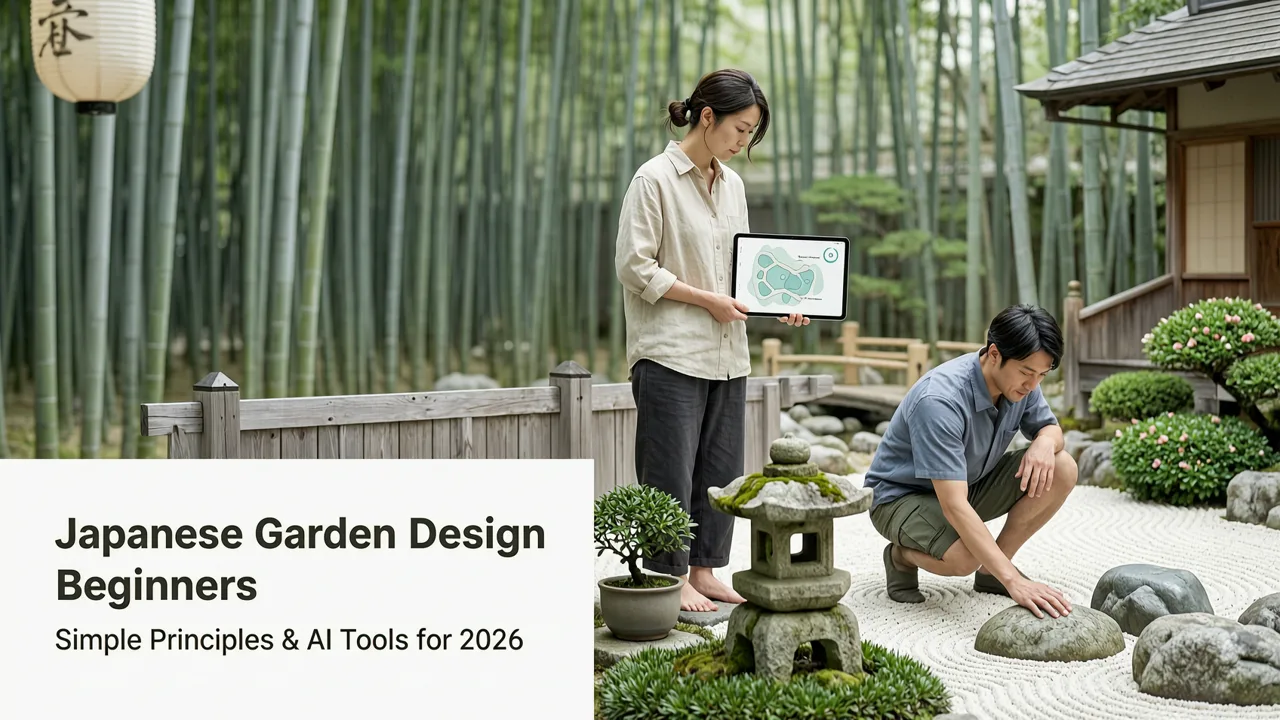
If you’ve searched for Japanese garden design for beginners, you’re likely standing barefoot on your backyard grass—or scrolling through photos of Ryoan-ji’s raked gravel at midnight—wondering: Where do I even start? You don’t need a master gardener’s license, a Kyoto apprenticeship, or decades of bonsai pruning to create a space that breathes stillness. In 2026, authentic Japanese garden design for beginners is more accessible than ever—not because tradition has been diluted, but because AI tools now help translate centuries-old principles into tangible, photorealistic previews—before you move a single stone.
Japanese Garden Design for Beginners: What It Really Means in 2026
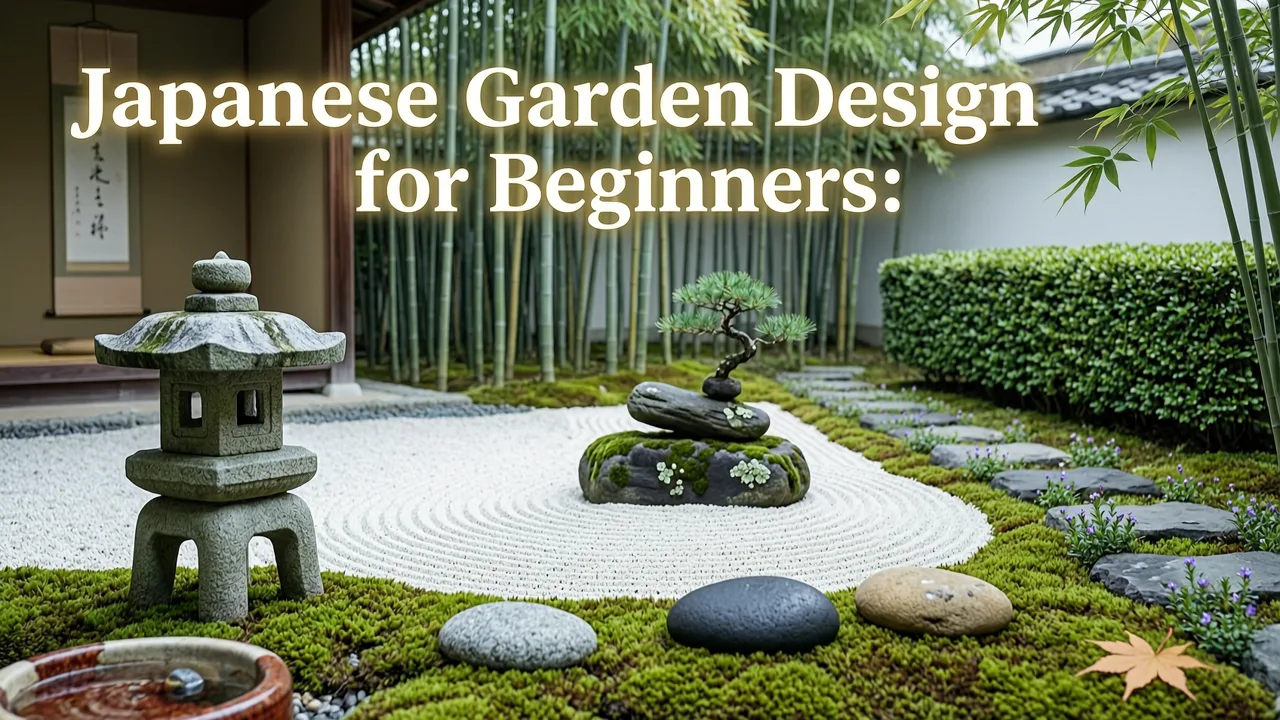
“Beginner” doesn’t mean “simplified.” It means intentional entry. A true Japanese garden isn’t about copying motifs—it’s about embodying philosophy: wabi-sabi (beauty in imperfection), shakkei (borrowed scenery), and ma (the art of intentional emptiness). For beginners in 2026, success isn’t measured by how many lanterns you install—but by whether your space invites pause, reflection, and subtle discovery.
What’s changed since 2024? Not the principles—but the scaffolding. Today’s best tools understand context: they recognize native soil types in your uploaded yard photo, suggest drought-tolerant substitutes for traditional shishi-odoshi bamboo deer scarers in arid climates, and simulate seasonal shifts (maple leaf fall, moss greening in spring) using geolocated weather data. That’s not magic—it’s trained cultural literacy, fused with real-world horticultural logic.
Top 8 Plants for a Japanese Garden // Zen Garden Ideas 🌸🌿
by Catchy Garden
The 5 Foundational Principles Every Beginner Must Know
Forget ornamental checklists. These five principles anchor every authentic Japanese garden—regardless of size, budget, or region:
- Asymmetry (Fukinsei): Perfect symmetry feels static; imbalance invites movement and curiosity. A lone maple beside an off-center stone path creates dynamic tension—not disorder.
- Symbolism over Literalism: A single boulder isn’t just rock—it may represent Mount Fuji, a dragon’s spine, or ancestral strength. Beginners often mistake literal ponds for koi habitats; in fact, dry gravel “oceans” (like those at Daitoku-ji) symbolize water more powerfully than any liner.
- Scale & Proportion (Kanso): Everything relates intentionally. A small garden doesn’t shrink elements—it rethinks scale: a 12-inch stone lantern becomes monumental when framed by low creeping juniper and negative space.
- Natural Materials, Unadorned: Wood should show grain and weathering. Stone must feel rooted—not polished or painted. Moss isn’t decoration; it’s evidence of patience and microclimate harmony.
- Controlled Viewpoints (Miegakure): Nothing is fully revealed at once. A curved path hides the next element; a clipped hedge frames only one branch of a pine. This choreography rewards slow walking—not Instagram scrolling.
Why Most Beginners Start Wrong (and How to Pivot)
Here’s what nearly every first-time designer does—and why it derails authenticity:
- Mistake #1: Buying “Japanese garden kits” — Pre-packaged lanterns, bridges, and gravel sets ignore site-specificity. A red bridge belongs beside water—not across dry mulch. A stone lantern loses meaning without a focal point (a gate, a bench, a specimen tree).
- Mistake #2: Prioritizing ornament over structure — Lanterns, pagodas, and koi are accents, not anchors. Without strong bones (path alignment, grade transitions, plant layering), they read as theme-park props.
- Mistake #3: Ignoring microclimate — Japanese maples wilt in full afternoon sun; moss dies under dripping AC units. Beginners often select plants for aesthetics alone—then battle stress for years.
The pivot? Start with what’s already there. Observe sun patterns for 3 days. Note existing trees, slopes, and drainage. Sketch sightlines from your kitchen window or patio door. Your garden begins where your feet stand—not where Pinterest says it should.
Core Elements of Japanese Garden Design for Beginners (Simplified & Purpose-Built)
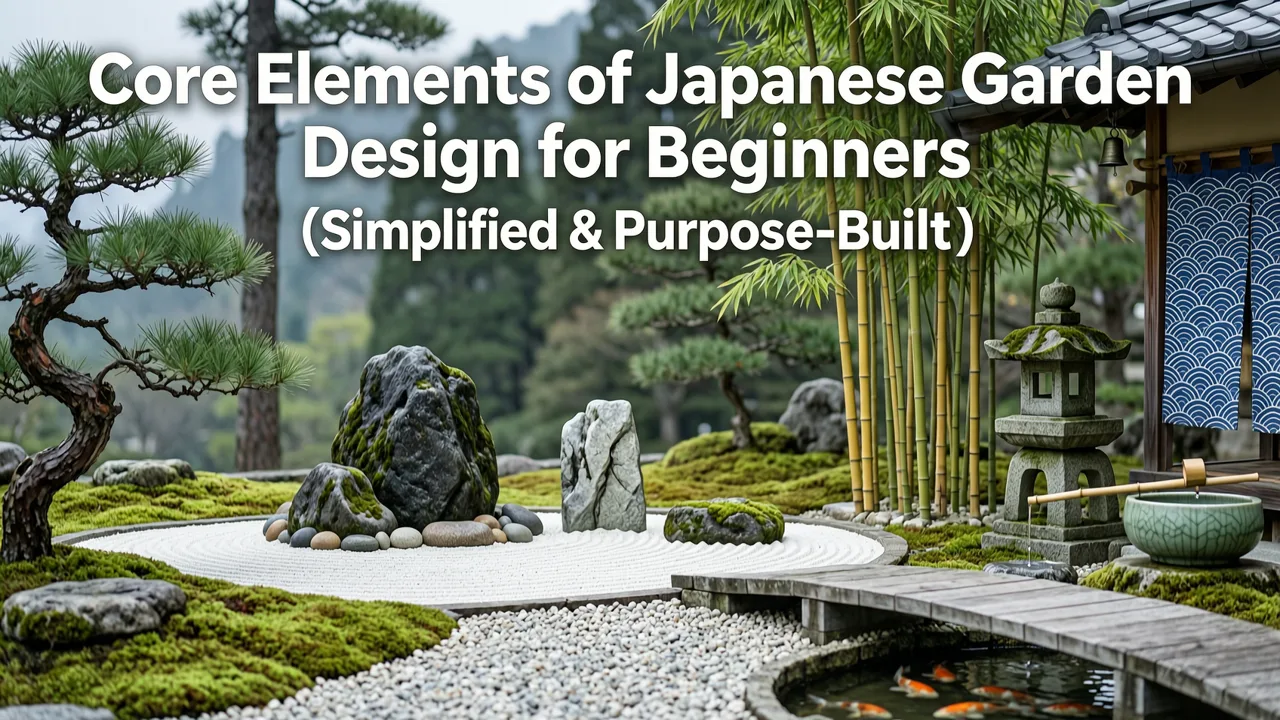
Forget memorizing 50+ terms. Focus on these six elements—the minimum viable framework for coherence, scalability, and meaning:
1. The Entry Sequence (Genkan Approach)
In Japanese homes, the genkan is a transitional threshold: you remove shoes, shift posture, adjust awareness. Your garden needs one too—even if it’s just a narrow stepping-stone path flanked by clipped boxwood and a single stone basin (tsukubai). No grand gate required. In small urban yards, this can be as subtle as a change in paving material or a low bamboo screen that forces a slight turn before entering the main space.
This principle is especially powerful for renters or those with HOA restrictions—no permanent build needed. As explored in our guide to modern Japanese garden layout ideas for small yards in 2026, the entry sequence is the most adaptable, high-impact starting point.
2. Ground Plane: Gravel, Moss, or Mulch?
Gravel (shishi-odoshi style or fine river pebbles) is iconic—but not mandatory. For beginners in dry climates or high-traffic areas, consider alternatives:
| Material | Ideal For | Beginner Tip | Maintenance Level |
|---|---|---|---|
| Fine crushed granite (light gray) | Formal dry gardens, courtyards | Rake in parallel lines away from focal points—not decorative swirls | Low (rake 2x/week) |
| Native groundcover (e.g., creeping thyme, sedum) | Slopes, erosion control, pollinator support | Plant in staggered clusters—not rows—to honor asymmetry | Medium (trim once/year) |
| Decomposed granite + moss plugs | Shaded, humid microclimates | Start with 3–5 moss varieties; let them merge naturally over 18 months | Medium-High (water daily for first month) |
| Dark basalt chips | Modern minimalist yards, fire pits zones | Pair with smooth river stones—not jagged rocks—for contrast | Low |
3. Stone: Your Garden’s Bones
Stones aren’t decor—they’re structural anchors and symbolic figures. Beginners should follow three rules:
- Group in odd numbers (3, 5, or 7)—never two or four. Even numbers imply duality; odd numbers suggest natural abundance.
- Anchor vertically: One tall, upright stone (representing heaven or male energy) paired with two lower, horizontal stones (earth/female energy) creates stable yin-yang balance.
- Source locally: Granite from New England, basalt from the Pacific Northwest, or limestone from Kentucky carries regional resonance. Importing Japanese stones defeats the spirit of shizen (naturalness).
Avoid “garden center” stones with uniform shapes. Look for glacial erratics, river-worn boulders, or quarry remnants with visible strata and weathering.
4. Plants: Less Is More (and Seasonal Shifts Matter)
Japanese gardens celebrate shun-ka-sho—the fleeting beauty of each season. Beginners often overplant. Instead, curate a tight palette:
- Evergreen backbone: Japanese black pine (Pinus thunbergii), dwarf hinoki cypress (Chamaecyparis obtusa ‘Nana’), or leatherleaf viburnum (Viburnum rhytidophyllum)
- Seasonal punctuation: Japanese maple (Acer palmatum) for spring leaf and autumn fire; flowering quince (Chaenomeles speciosa) for early spring bloom; winterberry holly (Ilex verticillata) for stark red berries against snow
- Ground-level rhythm: Sedges (Carex spp.), mondo grass (Ophiopogon japonicus), or ferns (Polystichum munitum) for texture—not color
Pro tip: Use your phone’s camera to capture your yard in all four seasons—even if virtually. Note where light pools in March, where frost lingers in November. This observational habit is more valuable than any app.
5. Water: Real, Symbolic, or Absent
Water embodies flow, reflection, and impermanence. But beginners often misinterpret its role:
- Real water requires pumps, liners, filtration, and algae management—best reserved for committed practitioners or professional installation.
- Suggestive water uses raked gravel, blue-tinted glass chips, or shallow reflective pools (still water, no fountain) to evoke surface calm.
- Absent water is equally valid. Dry gardens (karesansui) like Ryoan-ji rely entirely on stone, gravel, and perspective to imply ocean, islands, or rivers.
In urban or rental settings, a simple tsukubai (stone water basin) with bamboo dipper offers ritual without plumbing—ideal for patios or balconies.
6. Structures: Gate, Lantern, Bridge—Only If They Serve
Structures must earn their place. Ask before adding:
- Does this gate mark a meaningful transition—not just an entrance?
- Does this lantern illuminate a path or focal point—or just add clutter?
- Does this bridge cross actual water—or is it a forced prop?
In small spaces, reinterpret structures: a low wooden bench (ishidoro-style base) becomes both seat and sculpture; a single carved stone post stands in for a full torii gate; a curved plank over gravel implies crossing without engineering.
How AI Tools Accelerate Learning—Without Replacing Judgment

AI isn’t here to design your garden for you. It’s here to compress decades of trial-and-error into minutes of informed iteration. In 2026, the best AI tools for Japanese garden design for beginners go beyond image generation—they incorporate horticultural databases, regional climate models, and stylistic guardrails trained on UNESCO-recognized gardens.
For example, our AI Japanese Garden Visualizer doesn’t just swap in a lantern. It analyzes your uploaded yard photo for:
- Sun exposure (via shadow mapping + geolocation)
- Soil type inference (from vegetation, texture, and regional data)
- Existing hardscape angles (to align new paths with natural flow)
- Scale reference (using known objects like doors or windows to calibrate proportions)
Then, it generates options grounded in authenticity—not algorithmic randomness. Choose “Zen Courtyard” and it prioritizes gravel, stone, and minimal planting. Select “Tea Garden” and it adds a recessed seating area, stepping stones, and a subtle chōzubachi basin—all scaled correctly to your space.
This bridges the gap between theory and execution—a critical need for beginners who understand wabi-sabi conceptually but struggle to translate it into a 20×30-foot suburban lot. As noted in our deep-dive on the best Japanese garden design app for 2026, accuracy in spatial reasoning and cultural fidelity separates utility from gimmick.
Using AI Responsibly: What the Tech Can—and Cannot—Do
Responsible AI use means knowing its limits. Per Google AI guidance on ethical design, tools should augment human judgment—not override it (Google AI Responsibility). Here’s the 2026 reality:
- Can do: Simulate seasonal plant growth, test lighting at 4 p.m. in October, preview how gravel color affects perceived space, compare maintenance load of 3 moss species.
- Cannot do: Replace soil testing, diagnose fungal disease in existing trees, interpret local HOA bylaws, or sense the emotional weight of a specific stone’s placement.
Treat AI as your most diligent apprentice—not your master gardener. Run 5 variations. Print the top two. Sit with them on your porch for a week. Then walk your yard again—measuring, touching, listening. That embodied knowledge is irreplaceable.
Getting Started: A 7-Day Beginner Action Plan
No overwhelm. Just seven focused steps—each taking ≤30 minutes:
- Day 1: Observe & Document — Stand in your yard at sunrise and sunset. Take 3 photos: wide angle, eye-level path view, and close-up of one interesting texture (bark, stone, leaf).
- Day 2: Map Sun & Shade — Sketch a rough overhead map. Mark full sun (6+ hrs), partial (3–6 hrs), and shade (<3 hrs) zones using free apps like Sun Surveyor.
- Day 3: Define Your Intent — Write one sentence: “I want this space to help me feel ______ when I’m here.” (e.g., “...feel grounded after work,” “...offer quiet for morning tea,” “...create a sanctuary for my children to explore slowly.”)
- Day 4: Choose One Anchor Element — Pick just one: a stone, a bench, a single tree, or a water feature. Research its symbolism and ideal placement.
- Day 5: Upload & Visualize — Use our AI Japanese Garden Visualizer to generate 3 versions based on your Day 1–4 notes.
- Day 6: Compare & Reflect — Print visuals. Place them where you’ll see them daily. Which one makes you pause longest? Why?
- Day 7: Make One Physical Change — Move one stone. Prune one branch. Lay three stepping stones. Do it slowly. Notice how it changes your walk, your breath, your attention.
This plan mirrors the ethos of shoshin—beginner’s mind. It’s not about perfection. It’s about showing up with curiosity, not certainty.
Common Questions Beginners Ask (and Straight Answers)
“Do I need a water feature?” — No. Many of Japan’s most revered gardens—like Saihō-ji (Moss Temple) or Kōryū-ji—are waterless. Stillness is more essential than flow.
“Can I mix Japanese elements with modern landscaping?” — Yes—if intention guides fusion. A corten steel edging around raked gravel honors wabi-sabi (rust as beauty); a minimalist concrete bench echoes kanso (simplicity). Avoid pastiche: don’t pair koi ponds with plastic flamingos.
“How long until moss takes hold?” — Realistically: 12–24 months for full coverage, depending on shade, moisture, and pH. Begin with shade-tolerant species like Thuidium delicatulum (fern moss) or Hypnum cupressiforme (sheet moss). Our guide to AI garden design for small yards includes moss compatibility filters by microclimate.
“Is it cultural appropriation to make a Japanese garden outside Japan?” — Not if approached with respect, research, and humility. Study primary sources. Visit authentic gardens. Hire Japanese-trained designers when possible. Acknowledge lineage—not just aesthetics. As OpenAI’s documentation emphasizes, responsible AI use requires contextual awareness—not just prompt engineering (OpenAI Platform Docs).
Conclusion: Your Garden Begins With a Single Step—Not a Perfect Plan
Japanese garden design for beginners isn’t about achieving Kyoto perfection. It’s about cultivating presence—in your space and yourself. Every raked line, every placed stone, every pruned branch is practice in attention. In 2026, AI tools remove guesswork—not meaning. They let you see consequences before commitment, test reverence before renovation, and honor tradition without imitation.
So start small. Start slow. Upload your first yard photo. Let the AI show you possibilities—not prescriptions. Then step outside, breathe, and ask: What does this place need—not what does it lack?
Ready to visualize your first authentic Japanese garden iteration? Try our AI Japanese Garden Visualizer today—free, no sign-up required.