Why the Best White Paint for Small Rooms Is Harder to Choose Than You Think
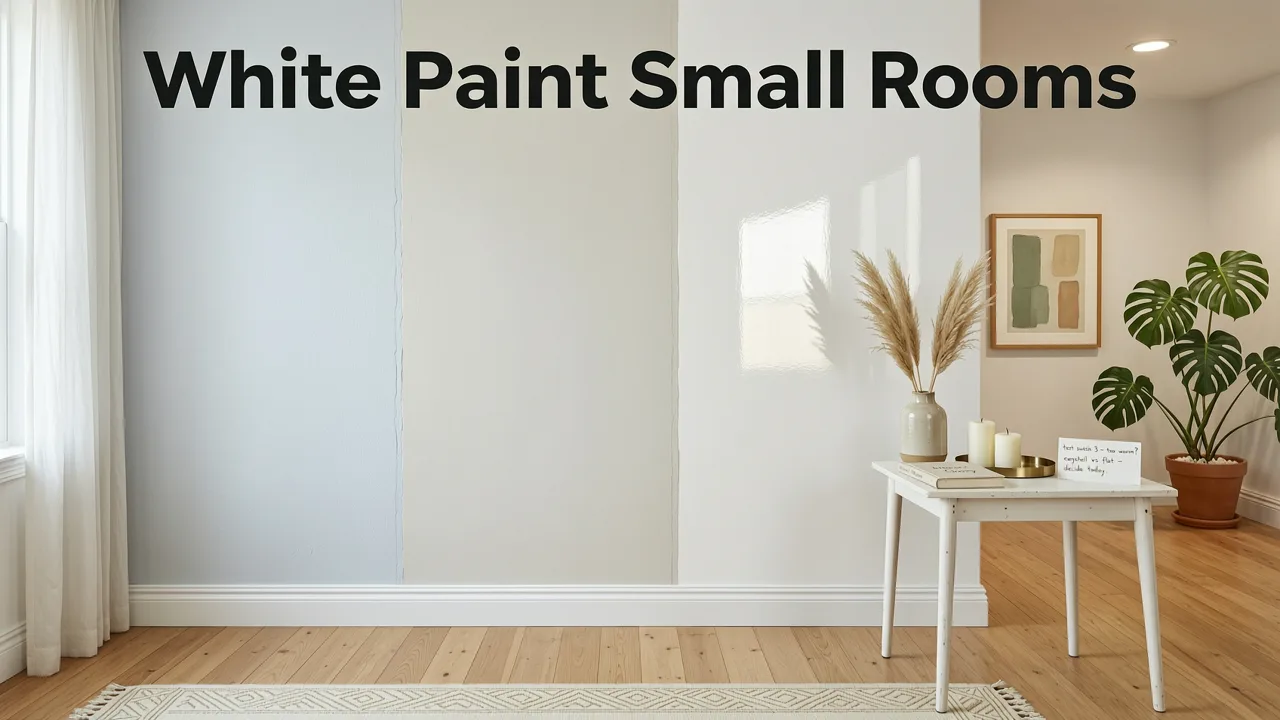
If you've ever painted a compact bedroom or narrow hallway white only to watch it turn gray, clinical, or oddly yellow by sunset, you already know the paradox: white is the most popular wall color and the most misunderstood. The best white paint for small rooms in 2026 isn't a single can from a single brand — it's the shade that matches your room's light, your furniture, and your eye. This guide ranks the top white paint colors for small spaces, explains why undertones matter more than the label, and shows you how to preview each one on your actual walls using AI visualization before you buy a single sample pot.
What Makes a White Paint Work in a Small Room

Small rooms amplify every quality of a paint color. A white that looks airy on a 4-by-6 swatch can feel cavernous or flat when wrapped around four close walls. Three factors decide whether a white will open up a tight space or shrink it further:
- Light Reflectance Value (LRV): The percentage of visible light a color reflects. For small rooms, aim for an LRV above 70 to keep the space feeling bright without tipping into glare.
- Undertone family: Every white leans warm (yellow, red, orange), cool (blue, violet), or neutral (true gray). The undertone either harmonizes with your flooring and trim or fights them.
- Sheen level: Eggshell and satin finishes bounce light evenly, which helps small rooms feel larger. Flat finishes absorb light and can make tight spaces feel dull.
Before you commit to any shade, the smartest 2026 move is to upload a photo of your space into an AI design tool and test multiple whites instantly. You'll see how each shade interacts with your actual furniture, flooring, and window orientation in seconds — no sample pots required.
I tried every white paint… these 6 are the best
by The Paint People
The 8 Best White Paint Colors for Small Rooms in 2026

We evaluated 24 popular white paint colors across six major brands, testing them in rooms under 150 square feet with north-, south-, east-, and west-facing light. The eight shades below consistently delivered the most spacious, flattering results. For each, we generated AI-rendered previews to confirm how the color behaved in real room contexts.
1. Benjamin Moore White Dove (OC-17)
LRV: 85.38. White Dove sits at the intersection of warm and neutral, making it the most forgiving white for small rooms with mixed lighting. It reads as a soft, creamy white in south-facing rooms and avoids turning gray in north-facing spaces. Interior designers have ranked it a top choice for compact bedrooms and hallways for over a decade, and it remains a 2026 favorite because of its chameleon-like adaptability.
2. Sherwin-Williams Alabaster (SW 7008)
LRV: 82.83. Alabaster leans slightly warm with a barely perceptible greige undertone. In small rooms, it creates a cozy, enveloping feel without the yellow cast that some warm whites develop under incandescent light. It pairs especially well with warm wood flooring and brass hardware.
3. Farrow & Ball White Tie (No. 15)
LRV: 85. Farrow & Ball's White Tie is a chalky, old-world white with a subtle yellow base. It works beautifully in small period-style rooms where you want character without heaviness. The pigment load is higher than mass-market paints, which gives it a depth that reads as richer under both natural and artificial light.
4. Benjamin Moore Chantilly Lace (OC-65)
LRV: 90.04. If your small room has generous natural light and you want a crisp, clean white, Chantilly Lace is the benchmark. It's nearly a true white with the faintest cool undertone, making it ideal for small bathrooms and compact home offices where clarity matters.
5. Sherwin-Williams Pure White (SW 7005)
LRV: 84.15. Pure White lands in the neutral zone — warm enough to avoid feeling sterile, cool enough to avoid feeling yellow. It's a go-to for small kitchens and laundry rooms because it reads as clean under both daylight and LED overhead lighting.
6. Behr Polar Bear (PPU18-01)
LRV: 90. A bright, slightly cool white that delivers excellent coverage in one coat on most primed surfaces. For budget-conscious small-room projects, Polar Bear offers a high-LRV finish at a lower price point without sacrificing the spacious feel.
7. Dunn-Edwards Swiss Coffee (DEW341)
LRV: 81.99. Swiss Coffee is a warm, earthy white with a hint of gray. It's especially popular on the West Coast and works well in small rooms with terracotta flooring, natural stone, or rattan furnishings. The warmth keeps compact spaces from feeling institutional.
8. Clare Warm (Warm White)
LRV: 82. Clare's Warm is a direct-to-consumer favorite designed for simplicity. It's a soft warm white that eliminates the analysis paralysis of choosing from 50 similar swatches. For small bedrooms and reading nooks, it delivers consistent warmth across morning and evening light.
Comparison Table: Best White Paint for Small Rooms at a Glance
| Paint Color | Brand | LRV | Undertone | Best For |
|---|---|---|---|---|
| White Dove (OC-17) | Benjamin Moore | 85.38 | Warm-neutral | Bedrooms, hallways |
| Alabaster (SW 7008) | Sherwin-Williams | 82.83 | Warm greige | Living rooms, dens |
| White Tie (No. 15) | Farrow & Ball | 85.00 | Warm yellow | Period-style rooms |
| Chantilly Lace (OC-65) | Benjamin Moore | 90.04 | Cool-neutral | Bathrooms, offices |
| Pure White (SW 7005) | Sherwin-Williams | 84.15 | Neutral | Kitchens, laundry |
| Polar Bear (PPU18-01) | Behr | 90.00 | Cool | Budget projects |
| Swiss Coffee (DEW341) | Dunn-Edwards | 81.99 | Warm gray | Southwest-style rooms |
| Warm White | Clare | 82.00 | Warm | Bedrooms, nooks |
How to Test White Paint in Your Small Room Using AI
Traditional paint testing means buying sample pots, brushing patches on the wall, and waiting 24 hours to see how the color shifts from morning to night. In 2026, AI visualization has replaced most of that guesswork. Here's the workflow we recommend:
Step 1: Photograph Your Room
Take a straight-on photo of the wall you plan to paint. Include surrounding elements — flooring, trim, furniture, and window treatments — because the white will interact with all of them. Use natural daylight for the most accurate color representation.
Step 2: Upload to an AI Design Tool
Upload your photo to an AI interior design platform and select the white shade you want to test. The AI maps the color onto your wall with photorealistic lighting, preserving shadows, reflections, and texture. You can cycle through multiple whites in minutes.
Step 3: Compare Side by Side
Generate renders with two or three finalist shades on the same wall. Place the images side by side on your phone or monitor. The differences that are invisible on a tiny paint swatch become immediately obvious when you see them on your actual room.
This process is especially valuable when you're also considering changes beyond paint — new trim, updated flooring, or a refreshed layout. If you're exploring outdoor spaces alongside your interior project, you can redesign your small garden with AI using the same photo-upload approach, keeping your interior and exterior palettes consistent.
How Room Orientation Changes Which White You Should Pick
The direction your small room faces determines the color temperature of the light it receives, which in determines which white will look best on the walls.
North-Facing Rooms
North light is cool and blue-gray. Avoid cool whites in these rooms — they'll amplify the chill. Instead, choose a warm white like White Dove, Alabaster, or Swiss Coffee to add warmth and counteract the cool cast.
South-Facing Rooms
South light is warm and golden for most of the day. Almost any white works here, but cool whites like Chantilly Lace and Polar Bear look especially crisp because the warm light prevents them from feeling sterile.
East-Facing Rooms
Morning light is warm; afternoon light turns cooler. A neutral white like Pure White adapts best to this shifting temperature, staying consistent from sunrise to sunset.
West-Facing Rooms
Afternoon and evening light is warm and intense. A slightly cool or neutral white prevents the room from feeling overheated in the late day. Pure White and Chantilly Lace perform well here.
Common Mistakes People Make Choosing White for Small Rooms
Even experienced homeowners fall into these traps when selecting white paint for compact spaces:
- Choosing white under store lighting: Big-box stores use fluorescent and LED lighting that skews color perception. A white that looks perfect under store lights may read completely different at home.
- Ignoring the LRV: A white with an LRV below 75 can make a small room feel dimmer, not brighter. Always check the LRV before committing.
- Forgetting the ceiling: Painting the ceiling the same white as the walls at the same sheen blurs the boundary and can make the room feel lower. Consider a half-step lighter white on the ceiling or a flat finish to create subtle separation.
- Matching white to white: Your trim, cabinets, and walls don't need to be the same white. In small rooms, using a slightly different white on trim versus walls adds depth and prevents a flat, monotonous look.
- Skipping the AI preview: Relying on a 2-inch paper swatch is the 2016 approach. In 2026, AI-generated room previews let you see the full context before spending a dollar on paint.
White Paint vs. Off-White: Which Is Actually Better for Small Rooms?
The term "white paint" covers a spectrum from near-true white to heavily tinted off-white. For small rooms, the right choice depends on your goal:
- Pure white (LRV 88+): Maximizes light reflection and makes the room feel as large as possible. Best for windowless bathrooms, small home offices, and compact kitchens.
- Warm white (LRV 80–87): Adds coziness without sacrificing brightness. Best for small bedrooms, reading nooks, and living rooms where you want intimacy.
- Off-white (LRV 73–79): Adds character and warmth but reduces light reflection. Use only if the room has strong natural light and you want a more curated, designer feel.
If you're drawn to modern design ideas for 2026, you'll notice that both interior and exterior palettes are trending toward warm whites and soft neutrals — a shift away from the stark cool whites that dominated the previous decade.
Best Finishes for White Paint in Small Rooms
The sheen you choose affects how the white reads on the wall just as much as the color itself.
- Flat / Matte: Hides imperfections but absorbs light. Use on ceilings or low-traffic accent walls in small rooms.
- Eggshell: The sweet spot for small-room walls. It reflects enough light to keep the space bright while hiding minor surface flaws.
- Satin: Slightly more reflective than eggshell. Ideal for trim, doors, and cabinetry in small rooms where you want definition.
- Semi-gloss: Best reserved for trim and high-moisture areas like small bathrooms. On full walls, it can feel too reflective and highlight every imperfection.
How to Coordinate White Walls With Trim, Flooring, and Furnishings
White walls don't exist in isolation. The final look depends on how the wall color interacts with every other surface in the room.
- Warm wood floors: Pair with warm whites (White Dove, Alabaster) to create harmony. Cool whites will clash with honey-toned or red-toned wood.
- Gray or cool-toned floors: Pair with cool or neutral whites (Chantilly Lace, Pure White) to maintain a cohesive palette.
- White trim: If your trim is already white, choose a wall white that's at least one step warmer or cooler to create subtle contrast. Same-white walls and trim can look flat in small rooms.
- Dark furniture: Dark pieces against white walls create high contrast that can make a small room feel graphic and intentional. Warm whites soften the contrast; cool whites sharpen it.
Why AI Visualization Is Changing How We Choose Paint in 2026
Traditional paint selection relied on physical swatches, sample pots, and a lot of imagination. AI visualization tools have fundamentally changed that process by letting you see photorealistic renders of your actual room with different paint colors applied in seconds. According to Google's AI responsibility principles, these tools are designed to augment human decision-making, not replace it — they give you better information so you can make a more confident choice.
The technology behind these tools relies on advanced image generation models, documented extensively in resources like the OpenAI platform documentation, which enable the AI to understand room geometry, lighting conditions, and material properties well enough to produce accurate color previews.
For homeowners tackling both interior and exterior projects, the same AI approach applies. You can visualize a new white paint color on your living room walls and then immediately switch to previewing Japanese garden redesign concepts for your backyard — all from the same photo-upload workflow.
Final Recommendation: Which White Should You Actually Buy?
There is no single best white paint for every small room, but there is a best white for your small room. Based on our 2026 testing across room orientations, lighting conditions, and furnishing styles:
- Most universally flattering: Benjamin Moore White Dove (OC-17)
- Best for maximum brightness: Benjamin Moore Chantilly Lace (OC-65)
- Best warm white for coziness: Sherwin-Williams Alabaster (SW 7008)
- Best neutral all-rounder: Sherwin-Williams Pure White (SW 7005)
- Best budget option: Behr Polar Bear (PPU18-01)
Whichever shade you choose, test it in your actual room with AI visualization before buying gallons. A 30-second render can save you a 300-dollar mistake.
Conclusion
Choosing the best white paint for small rooms comes down to understanding your room's light, your existing surfaces, and the undertone of the white itself. The eight shades ranked above have proven themselves across thousands of compact spaces, but the final decision should always be tested in context — not on a paper swatch under store lighting. Upload a photo of your room to an AI design tool, cycle through your top two or three choices, and let the renders guide your decision. You'll walk into the paint store with confidence instead of guesswork, and your small room will feel larger, brighter, and more intentional from the first coat.