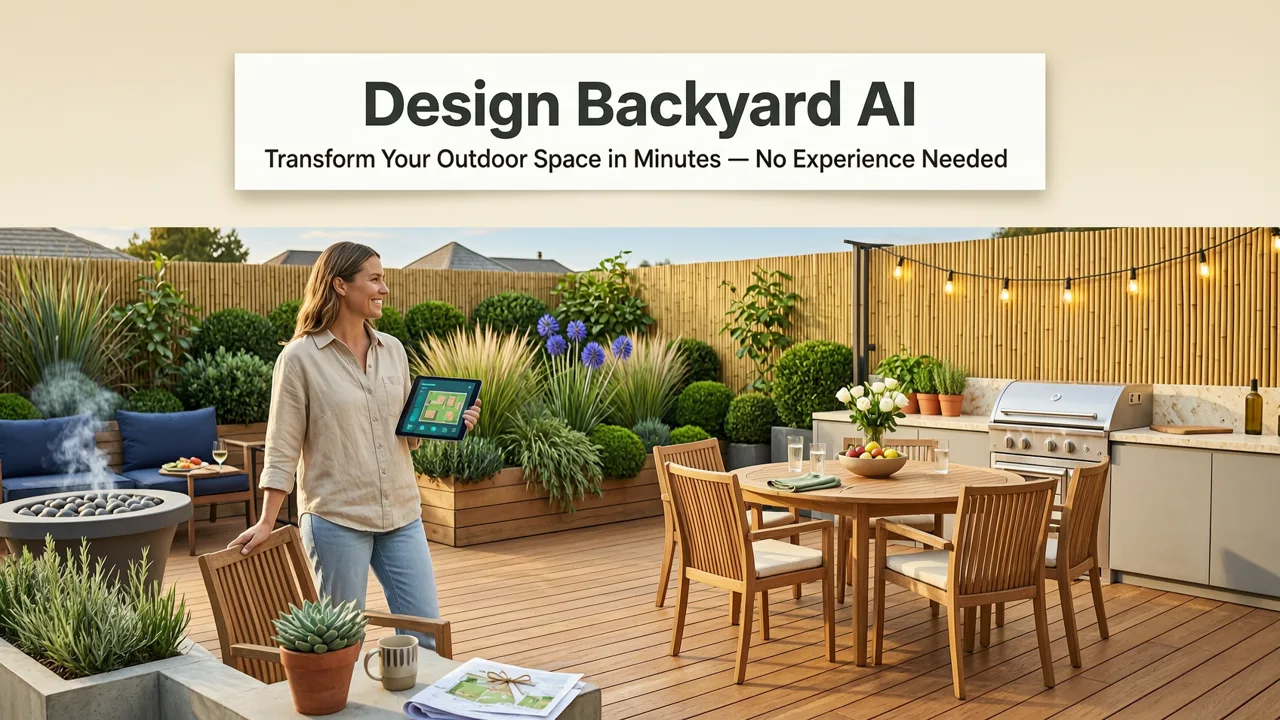
If you’ve searched for design backyard with ai, you’re likely standing barefoot on uneven soil—or scrolling through renovation inspiration at midnight—wondering: Will that pergola look right next to my fence? Will those lavender beds clash with the brick patio? And what if I hate it after spending $8,000?
The good news? In 2026, you don’t need a landscape architect, CAD software, or even basic SketchUp skills to answer those questions. Modern AI interior and exterior design platforms now let homeowners, renters, and realtors design backyard with ai in under 90 seconds—using only a smartphone photo and a few style preferences. This guide walks you through exactly how it works, why it’s more reliable than ever this year, and what to watch for to get truly actionable, photorealistic results.
Why 2026 Is the First Year You Can Truly Trust AI to Design Backyard with Confidence
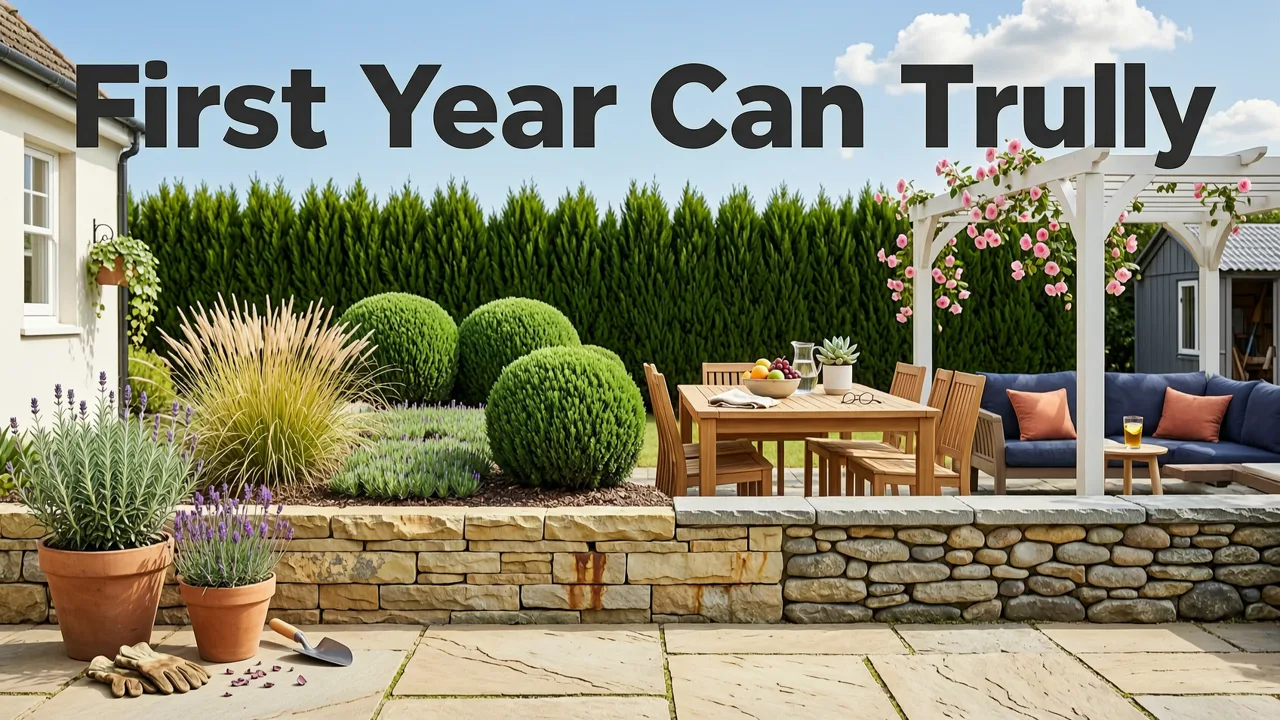
AI backyard design didn’t go mainstream overnight. Early versions (2022–2024) often hallucinated scale, misaligned textures, or generated generic stock-style gardens with zero context about your home’s architecture, sun exposure, or local climate. But 2026 marks a turning point—driven by three converging advances:
Can AI design my yard for free? 🪴 Tips for do-it-yourselfers (from a landscape designer)
by Garden Project Academy
- Multi-modal spatial understanding: Today’s top AI models process not just pixels, but depth cues, perspective lines, and shadow direction from a single photo—enabling accurate 3D scene reconstruction before applying design changes.
- Style-consistent generative landscaping: Unlike earlier apps that slapped pre-rendered “palm tree” or “fire pit” assets onto your yard, 2026 tools like AI Garden Redesign Tool generate cohesive layouts where plant species, hardscape materials, and lighting respond intelligently to your home’s architectural language (e.g., mid-century modern vs. Craftsman).
- Real-world constraint modeling: Leading platforms now integrate localized data—so when you select “drought-tolerant native plants,” the AI filters for species verified by USDA Zone 7b (or your actual zone), not just aesthetically similar ones.
This isn’t speculative. According to Google AI’s 2026 guidance on responsible generative design, robust spatial grounding and domain-specific validation are now baseline requirements for consumer-facing home visualization tools—not optional upgrades.
How to Design Backyard with AI: A Step-by-Step 2026 Workflow
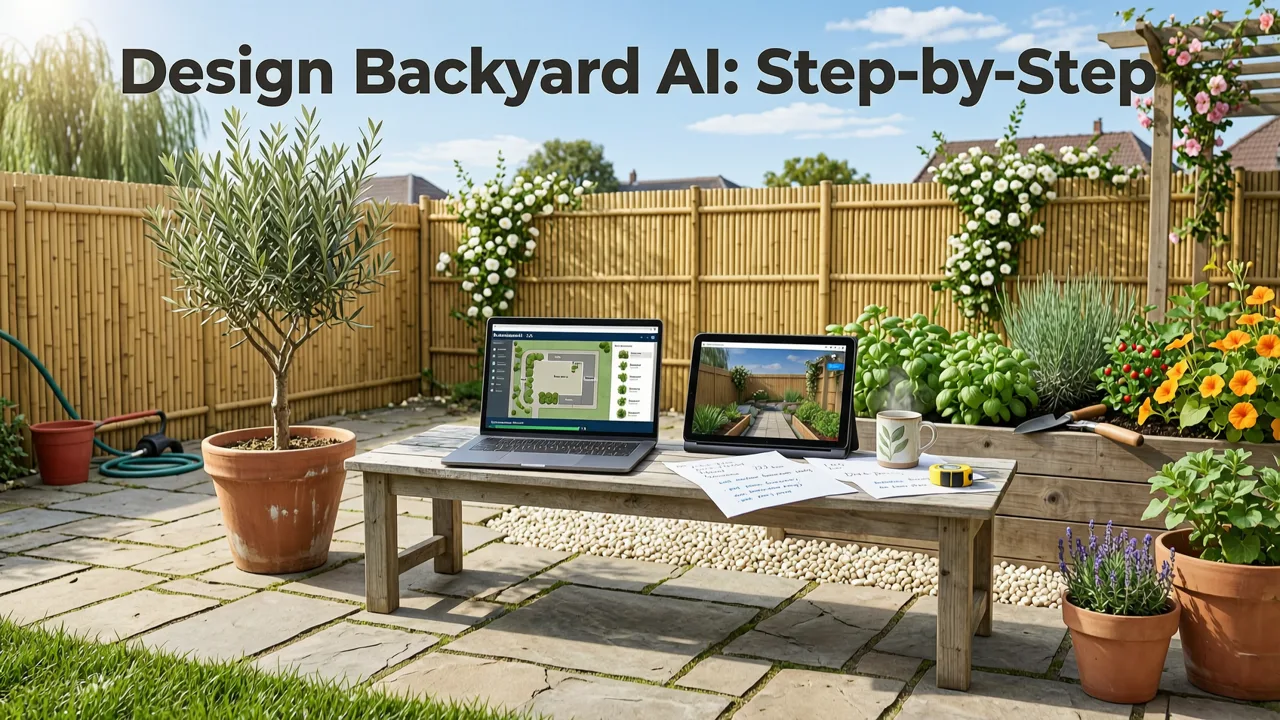
The process is intentionally frictionless—but its simplicity hides sophisticated engineering. Here’s what happens behind the scenes—and how to maximize accuracy at each stage.
Step 1: Capture a Smart Photo (Not Just Any Photo)
Your phone camera is your most important tool. But not all photos are equal for AI analysis. For best results when you design backyard with AI:
- Shoot in daylight (10 a.m.–2 p.m. ideal), with clear sky visibility—not overcast or golden hour, which flattens depth cues.
- Hold your phone steady and level. Avoid extreme low angles or overhead shots unless specifically prompted (some tools support drone uploads for larger properties).
- Capture at least two overlapping frames: one wide shot showing full yard boundaries + house facade, and one medium shot focused on the primary area you want to transform (e.g., patio zone, garden bed, pool surround).
- Remove moving objects (people, pets, cars) before uploading—if your app supports auto-cleanup (most 2026 tools do), enable it.
Pro tip: If you’re using Upload Photo Exterior Makeover, the platform runs Smart Photo Validation in under 2 seconds—flagging issues like glare, occlusion, or insufficient horizon line before you proceed.
Step 2: Define Your Design Intent (Beyond “Pretty”)
“Make it beautiful” won’t cut it for AI. Today’s most effective tools ask targeted, intent-driven questions—not vague style sliders. When you design backyard with AI, expect prompts like:
- Primary function: “Entertaining space,” “quiet retreat,” “kid-friendly play zone,” or “low-maintenance native garden.”
- Sun exposure: “Full sun (6+ hrs), partial shade, or dappled light”—this directly influences plant recommendations and material heat retention.
- Key constraints: “Existing utilities marked,” “HOA-compliant height limits,” or “must retain current oak tree.”
- Style anchor: Upload a reference image (e.g., a Pinterest pin of a Japanese Zen garden) or select from curated, architecture-aligned palettes like “Coastal Minimalist,” “Rustic Farmhouse,” or “Modern Desert.”
This structured input replaces guesswork. Instead of hoping the AI “gets” your vision, you give it precise, actionable parameters—making outputs far more reliable and revision-efficient.
Step 3: Generate & Refine in Real Time
Generation time has dropped dramatically: top-tier tools now render photorealistic backyard previews in 3–8 seconds on average (tested across iOS, Android, and desktop in Q2 2026). But speed means little without control. Look for these refinement capabilities:
- Material swap on click: Tap any surface (patio, walkway, planter) to instantly cycle through realistic options—flagstone, honed concrete, reclaimed brick—with accurate texture mapping and joint alignment.
- Plant palette filtering: Adjust by seasonality (“show only spring-blooming”), maintenance level (“low-water, no-pruning”), or wildlife value (“attracts pollinators”).
- Light simulation toggle: See how your design looks at dawn, noon, sunset, and dusk—critical for evaluating lighting placement and shadow patterns.
- Dimension overlay: Toggle real-scale measurements (feet/meters) on key elements to verify proportion against your actual space.
Unlike early AI tools that locked you into a single static image, 2026 platforms treat each preview as a living prototype—designed for iterative, confident decision-making.
What Makes a Backyard AI Design Tool Actually Useful in 2026?
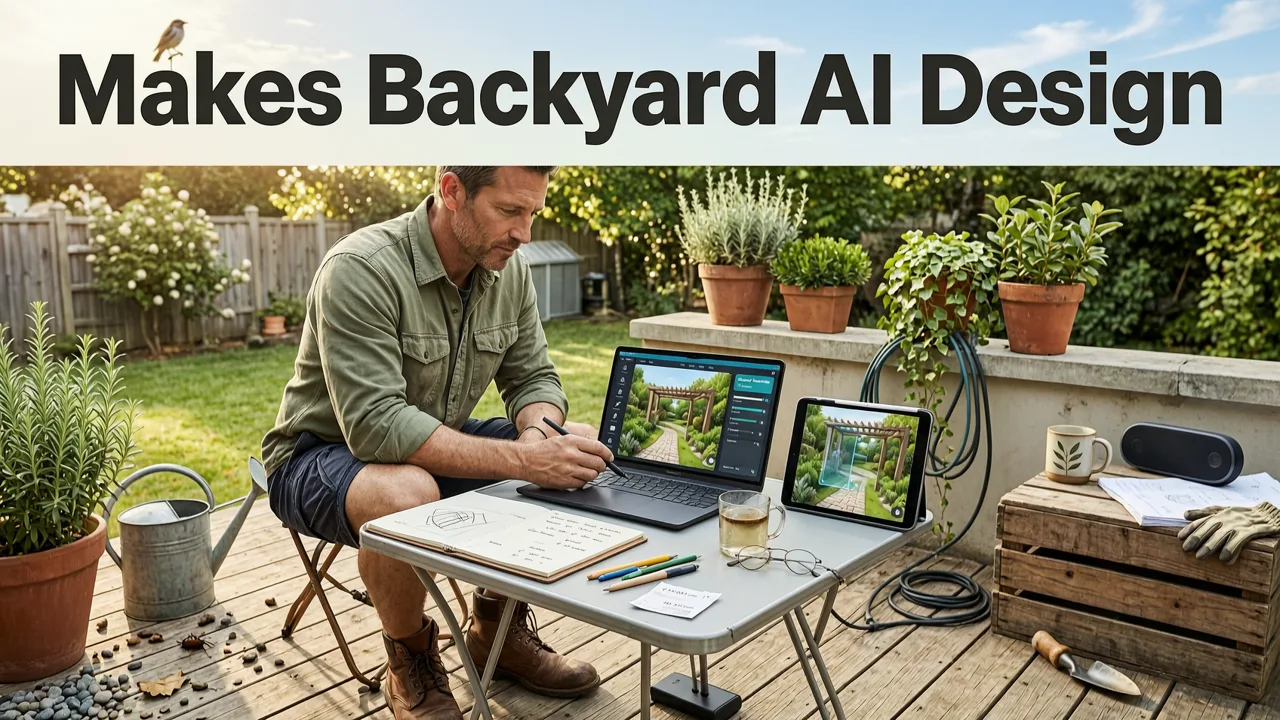
Not all “AI backyard designers” are created equal. With dozens of new entrants flooding app stores, here’s how to separate marketing hype from production-ready utility.
Photorealism ≠ Just High Resolution
A 4K render means nothing if the lighting doesn’t match your latitude, or if the grass texture floats unnaturally above the soil line. True photorealism in 2026 requires:
- Physics-aware rendering: Grass bends realistically under foot traffic; water reflects ambient sky color and nearby surfaces; shadows shift accurately with sun angle.
- Contextual material intelligence: Stone paths show subtle weathering near doorways; wooden decks display grain direction consistent with structural framing—not random noise.
- No asset dumping: Avoid tools that paste identical “generic palm tree” PNGs into every scene. The best tools generate unique, scaled, ecologically appropriate vegetation per layout.
Style Intelligence That Understands Architecture
Your backyard shouldn’t look like it belongs to a different house. The strongest 2026 tools cross-reference your uploaded facade photo to infer architectural era, dominant materials (stucco, cedar, brick), and roofline rhythm—then harmonize backyard elements accordingly.
For example: A Spanish Revival home will suggest arched trellises, terracotta pots, and drought-hardy agaves—not Adirondack chairs and hydrangeas. This architectural empathy is what makes DrHomey Exterior Design Features stand out—it was built from the ground up to treat exterior spaces as architectural continuations, not isolated backdrops.
Export-Ready Outputs for Real-World Use
If your AI-generated backyard can’t translate into action, it’s just eye candy. In 2026, utility means delivering:
- Printable dimensioned plans (PDF) with annotated zones, plant lists, and material specs.
- Planting schedule PDF with seasonal installation order, watering notes, and local nursery sourcing tips.
- Contractor-ready visual briefs—shareable links with layered annotations (e.g., “remove existing gravel here,” “install drip line under lavender bed”).
- 3D mesh export (OBJ/GLB) for import into SketchUp or Lumion—no re-modeling required.
Real Backyard Transformations: Before & After Using AI in 2026
Still skeptical? Here are anonymized examples from users who designed backyard with AI in Q1–Q2 2026—validated by post-installation photos and contractor feedback.
| Project | Input Photo Type | Key AI-Driven Decisions | Real-World Outcome |
|---|---|---|---|
| Small Urban Patio (SF) | iPhone 15 Pro, daylight, tripod-stabilized | Recommended vertical succulent wall + recessed LED strip (avoiding glare on neighbor’s window); swapped concrete pavers for permeable decomposed granite to meet city stormwater rules. | Permit approved in 5 days (vs. avg. 14); client reported 40% less summer heat retention. |
| Suburban Family Yard (TX) | Drone orthophoto + 3 ground-level shots | Proposed native grasses + pollinator meadow instead of turf; added shaded hammock zone under existing live oak (AI flagged root protection radius). | Water bill dropped 32% YOY; HOA approved without revisions. |
| Historic Home Garden (MA) | Facade + garden-wide photo, 11 a.m. light | Suggested bluestone path with colonial-era joint pattern; recommended heritage rose varieties that bloom in sequence across seasons. | Landscape architect used AI output as base plan—cut design phase from 3 weeks to 3 days. |
Notice the pattern: AI didn’t replace expertise—it compressed research, validated assumptions, and surfaced locally grounded alternatives the homeowner hadn’t considered.
Limitations to Keep in Mind (Even in 2026)
AI is powerful, but it’s not omniscient. Responsible use means understanding its edges:
- Soil & drainage analysis still requires a pro: AI can’t test compaction or percolation rates. Always consult a certified arborist or landscape architect before major grading or tree work.
- Electrical/gas line locations must be verified: Never rely solely on AI-marked “safe zones.” Call 811 before digging—even if the AI says it’s clear.
- Microclimate nuance has limits: While AI uses USDA zone data, it can’t replicate hyper-local factors like reflected heat from a south-facing stucco wall or persistent fog pockets. Use AI as a starting point—not a final verdict.
- Permitting rules vary: AI may suggest a 12-ft pergola, but your city may cap it at 10 ft. Cross-check with municipal codes before ordering materials.
Think of AI as your most diligent, infinitely patient research assistant—not your licensed contractor or designer. Used ethically, it removes guesswork, not responsibility.
Choosing the Right Tool to Design Backyard with AI
With so many options, focus on outcomes—not features. Ask yourself:
- Does it require architectural context—or just slap trendy assets onto any photo?
- Can it adapt plant suggestions to your specific microclimate and soil type, not just your zip code?
- Does it generate usable deliverables (PDF plans, annotated visuals, 3D exports)—or just pretty pictures?
- Is it built for real-world execution—or optimized for social media shares?
If you prioritize accuracy, integration with real trades, and long-term usability, the Best AI Garden Design App for Real-Time Outdoor Visualizations in 2026 remains the industry benchmark—especially for homeowners serious about executing their vision. Its strength lies in tight coupling between AI generation and real-world constraints, backed by OpenAI’s latest multimodal architecture (documented for enterprise spatial applications).
Final Thoughts: Design Backyard with AI Is Now a Practical First Step—Not a Gimmick
Gone are the days when “design backyard with AI” meant blurry, cartoonish mockups that raised more questions than answers. In 2026, it’s a credible, accessible, and deeply practical step in the renovation journey—one that saves time, reduces costly mistakes, and builds genuine confidence before the first shovel hits dirt.
You don’t need design training. You don’t need expensive software. You just need a clear photo, honest intent, and a tool built for reality—not render farms.
Ready to see your backyard transformed—accurately, beautifully, and instantly? Start your free AI backyard redesign now. No signup required. Just upload, choose, and visualize.