Why the Best AI App for Garden Visualization Is Essential in 2026
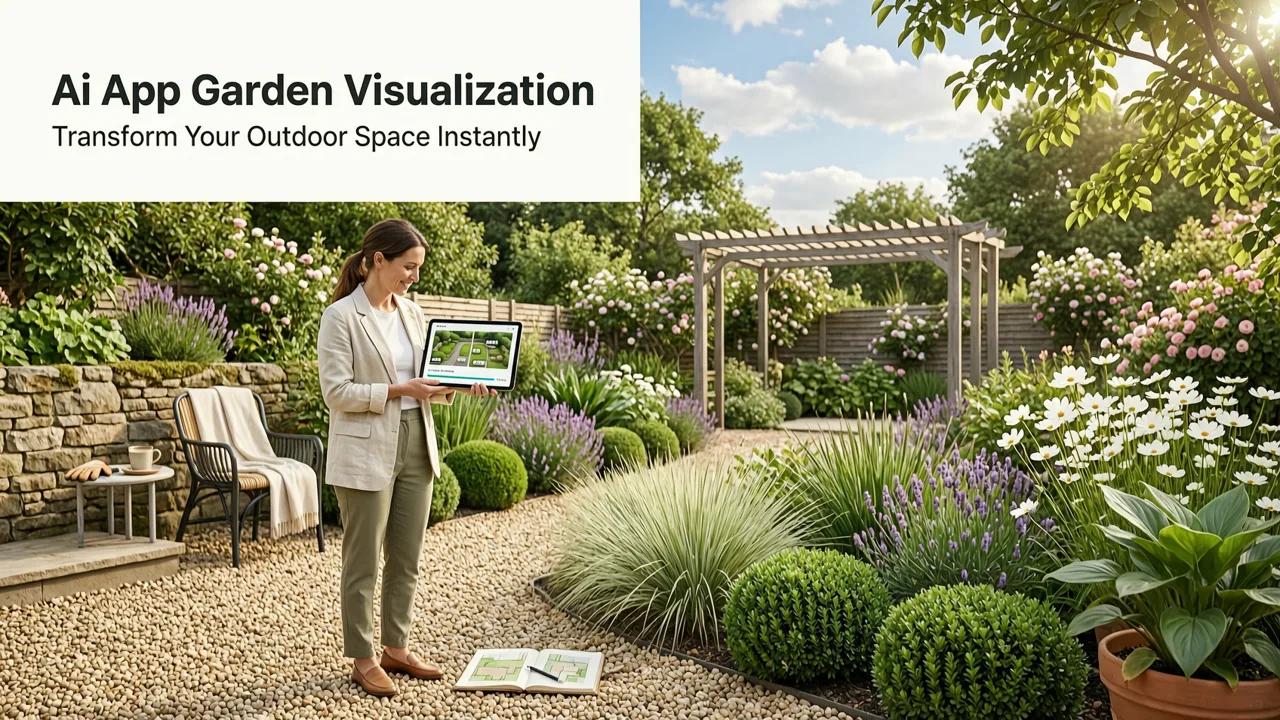
Landscaping and garden renovations are among the most expensive and irreversible home improvement projects. A single misplaced patio, an overgrown tree choice, or a clashing hardscape material can cost thousands of dollars to correct. If you have ever struggled to imagine how a new garden layout will actually look in your specific yard, you are not alone. The best AI app for garden visualization in 2026 solves this by combining photorealistic rendering with style-specific prompts to transform a simple photograph into a fully landscaped yard in seconds.
Modern AI landscaping tools have moved far beyond basic 2D overlays. Today’s virtual landscaping software uses advanced depth mapping and semantic segmentation to understand your existing yard. It identifies grass, soil, existing trees, and architectural structures, allowing it to generate highly accurate outdoor space rendering without erasing the features you want to keep. This technology empowers homeowners, realtors, and landscape architects to plan their perfect yard with absolute confidence before breaking ground.
What Makes a Garden Visualization Tool Actually Work
Understanding the technology behind these applications helps in selecting the right one. At their core, the leading AI garden makeover planners rely on generative AI models. According to foundational documentation on modern AI architecture, these models use diffusion processes and transformer networks to interpret text prompts and image inputs simultaneously.
AI Landscape Design Workflow | Nano Banana Pro Prompts Shared
by LandSpace Architecture
When you upload a photo of your backyard, the AI performs several complex tasks instantly. First, it maps the 3D geometry of the space, calculating perspective and lighting angles. Next, it segments the image, distinguishing between the sky, existing hardscape, and plantable areas. Finally, it applies the selected design style, generating new textures, plants, and structures that match the lighting and perspective of the original photo. This ensures the final image looks like a genuine photograph of your future garden, rather than a digital collage.
The Best AI App for Garden Visualization: Key Features to Look For
Not all AI design tools are created equal. When evaluating the best AI app for garden visualization, several critical features separate the professional-grade platforms from basic photo editors.
Hardscape and Structure Retention
A premium tool must allow you to lock specific elements. If you are keeping your existing deck, fence, or large oak tree, the AI needs to recognize and preserve these structures while only altering the surrounding landscape. Without hardscape visualization retention, you will spend more time editing out AI hallucinations than actually designing.
Botanical Accuracy and Responsible Generation
The AI should suggest plants that make sense for the visual context. Following responsible AI development guidelines, top-tier applications are being trained to avoid suggesting invasive species or plants that visually contradict the environment. While AI might not know your exact USDA hardiness zone without manual input, it should generate botanically plausible arrangements that serve as a reliable starting point for your garden makeover planner.
Lighting and Shadow Consistency
A photorealistic exterior design must respect the time of day and weather conditions of the original photo. The best tools calculate shadow cast directions and ambient light reflections, ensuring that a newly generated pergola casts a shadow in the exact same direction as your existing house.
Top Garden Visualization Styles You Can Generate
The versatility of an AI tool is defined by its style library. The most comprehensive platforms offer a wide array of aesthetic options to suit any architectural context.
- Modern Minimalist: Features clean lines, geometric planters, polished concrete pavers, and structured ornamental grasses.
- English Cottage: Focuses on lush, overflowing flower beds, winding stone pathways, wrought iron details, and a romantic, slightly wild aesthetic.
- Xeriscape and Drought-Tolerant: Ideal for arid climates, utilizing gravel, succulents, agave, natural boulders, and efficient drip-irrigation visual cues.
- Tropical Resort: Dense foliage, broad-leaf plants like monstera and bird of paradise, wooden decking, and water features.
- Japanese Zen: Emphasizes balance and tranquility with raked gravel, carefully pruned maples, bamboo fencing, and subtle stone lanterns.
How to Use AI for Your Exterior and Garden Makeover
Using a garden visualization tool is straightforward, but following a structured process yields the most accurate results.
- Capture a High-Quality Photo: Stand at the furthest point of your yard to capture the widest angle. Ensure the lighting is even; avoid harsh midday sun that creates overly contrasty shadows.
- Upload and Segment: Import the image into the AI platform. Use the masking tools to highlight areas you want to change (like an old lawn) and mask areas you want to keep (like a patio).
- Select Your Style and Prompt: Choose a base style from the library. If the tool allows custom text prompts, be specific. Instead of "add flowers," use "add vibrant purple lavender and white daisies along the stone pathway."
- Generate and Refine: Run the generation. Review the output for scale and perspective. Most tools allow you to regenerate specific areas or adjust the intensity of the changes.
- Export and Share: Download the high-resolution image to share with contractors, landscape architects, or family members.
Comparing the Best AI Apps for Garden Visualization
To understand why dedicated AI visualization platforms outperform traditional methods, consider the following comparison of design approaches.
| Feature | Dedicated AI Visualization App | Traditional 3D Modeling Software | Basic 2D Photo Editors |
|---|---|---|---|
| Setup Time | Seconds (upload and generate) | Hours to days (manual modeling) | Minutes (manual cut-and-paste) |
| Learning Curve | None (intuitive interface) | Steep (requires CAD/3D skills) | Moderate (requires editing skills) |
| Photorealism | High (AI matches lighting/texture) | Variable (depends on rendering engine) | Low (looks like a collage) |
| Perspective Accuracy | Automatic (AI calculates depth) | Manual (user must set camera angles) | Manual (user must warp images) |
| Cost | Subscription or credit-based | High (software + training time) | Low to Moderate |
Integrating Garden AI with Indoor Design Tools
Redesigning an outdoor space often inspires a fresh look at the home’s interior and exterior architecture. A cohesive design approach ensures that your garden complements your living spaces rather than clashing with them.
For instance, if your new garden features a minimalist aesthetic, you might want to update your home's exterior trim or indoor spaces to match. Understanding how light interacts with compact spaces is crucial during this transition, which is why exploring guides on the best white paint for small rooms can help maintain visual continuity from the garden into the house through consistent color palettes.
When adding structural elements to your yard, such as a painted fence, a privacy screen, or a trellis, you face a similar design choice to interior decorating: accent wall paint vs wallpaper. In the garden, this translates to choosing between a bold painted boundary or a lush, textured living wall. You can test these exterior color choices using a free accent wall paint visualizer to see how specific shades look against your greenery and hardscape before purchasing the paint.
Furthermore, just as interior tools rely on accurate light mapping to show how colors shift throughout the day, a tool offering white wall paint AI visualization uses similar shadow and reflection logic. This underlying technology ensures that your garden's hardscape, fences, and outdoor furniture look natural and correctly illuminated under different sunlight conditions.
Conclusion
Choosing the best AI app for garden visualization in 2026 comes down to finding a platform that balances photorealistic rendering with intuitive controls. By leveraging advanced generative AI, homeowners and design professionals can eliminate the guesswork from landscaping, ensuring that every plant, pathway, and patio is perfectly placed before a single shovel hits the dirt. Ready to transform your outdoor space? Explore the comprehensive exterior and garden visualization tools available at AI Design Interiors to bring your dream yard to life instantly.